HOW IT WORKS
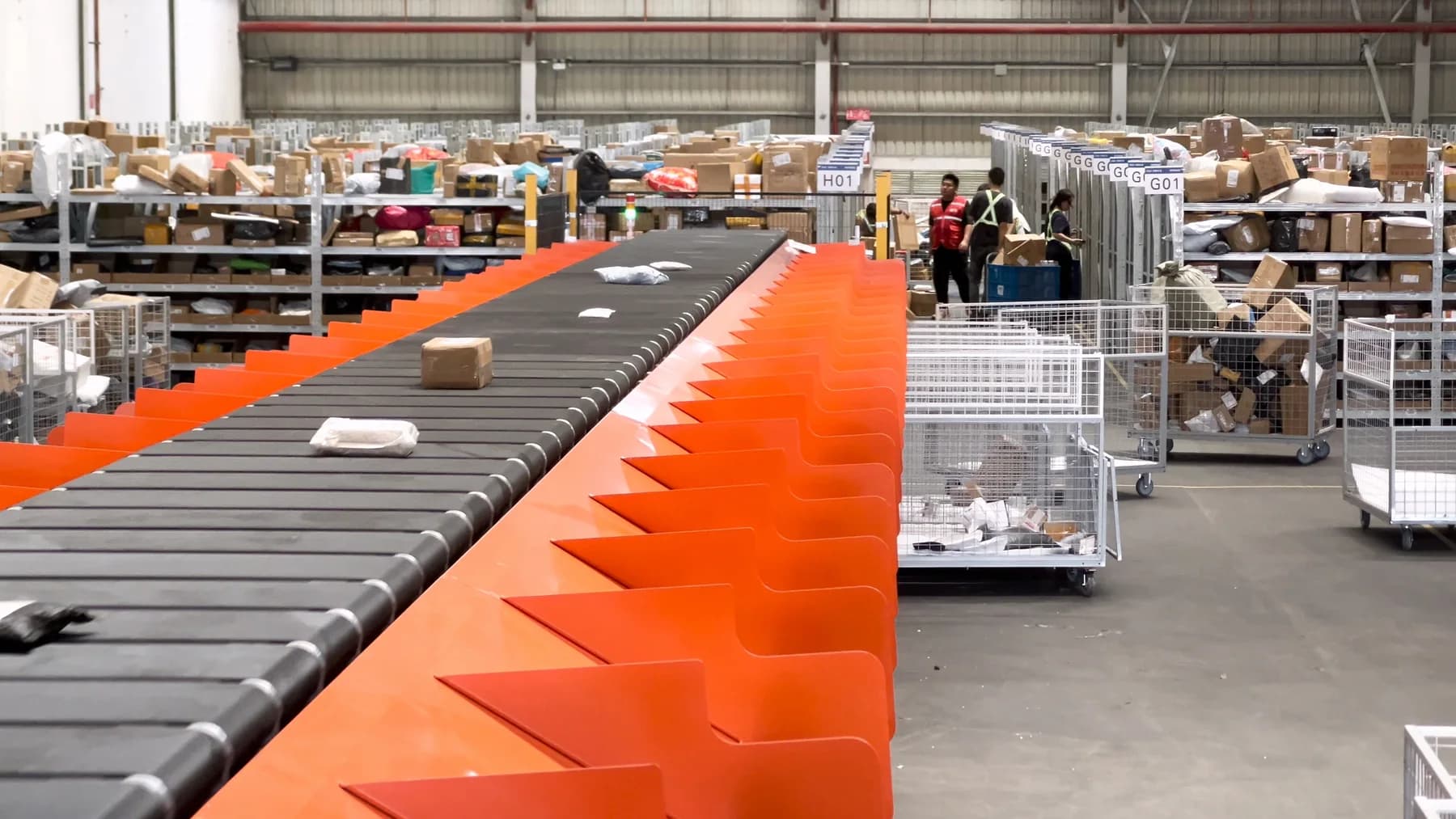
Narrow powered carrier belts move parcels laterally from a linear or loop transport path. Adjacent carriers may be coordinated for a wider parcel footprint, but the permissible combination must be defined by the controls and proven with representative items.
System boundary
A sorter is not a standalone mechanism. The following scope must be designed and accepted as one material-flow system.
- Narrow-belt carriers, powered rollers and idlers
- Carrier linkage, guidance and structural support
- Induction, parcel spacing and multi-carrier assignment
- Destinations, controls and safe service access
Inputs required for configuration
- Parcel width distribution and minimum stable contact area
- Single- versus multi-carrier operating rules
- Belt speed, discharge window and destination geometry
- Roller voltage, duty cycle and thermal limits
- Accumulated pitch, tracking and replacement access
Questions to answer before selection
- How wide is the parcel-size distribution?
- Will multiple carriers be linked for larger parcels?
- Where can maintenance access be preserved along the line?
Evidence to request from a supplier
- A controlled parcel-envelope drawing with minimum and maximum dimensions and weights.
- Sustained throughput assumptions, including induction efficiency, no-read and recirculation.
- Layout drawings showing structure, access, guarding, controls and maintenance clearance.
- A factory acceptance test plan linked to the representative parcel set.
- A commissioning boundary and documented spare-parts strategy for the local partner.
PUBLISHED REFERENCES
Configuration evidence, not universal ratings.
These values come from named MANZUN material. They describe the cited configuration and must not be applied to a different layout without recalculation.
MANZUN describes these carrier sizes for narrow-belt applications and multi-cart handling. Final dimensions and parcel limits require the applicable project drawing.
View MANZUN source ↗