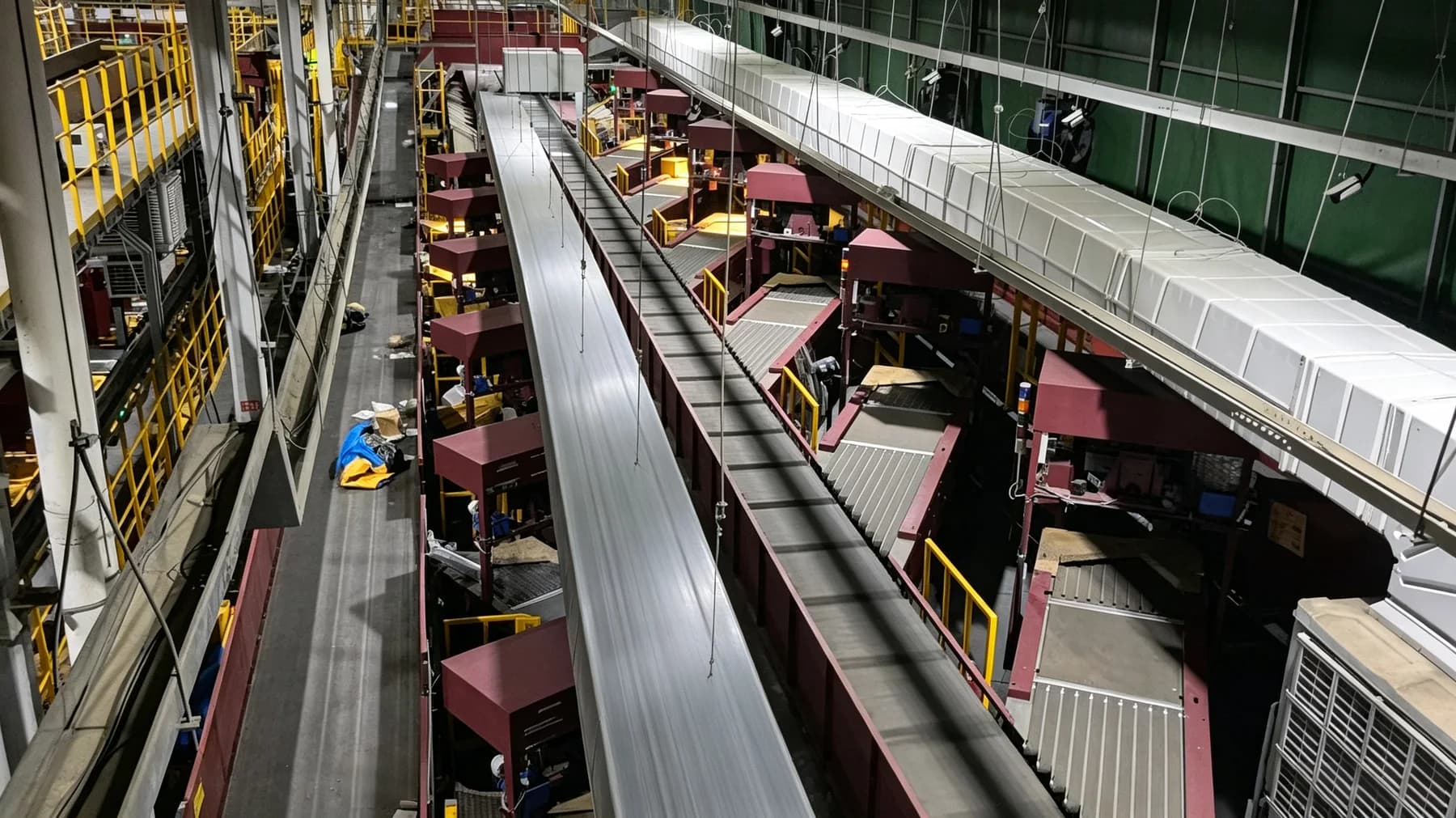
Short powered belts mounted on moving carriers discharge parcels laterally at assigned destinations. The complete system combines the closed-loop track, carriers, induction, identification, destination chutes, controls, guarding and service access.
System boundary
A sorter is not a standalone mechanism. The following scope must be designed and accepted as one material-flow system.
- Loop track, running frames and carrier assemblies
- Induction, weighing, scanning and carrier assignment
- Power distribution, communication and position control
- Destination chutes, recirculation and exception handling
Inputs required for configuration
- Sustained peak-hour flow and parcel arrival profile
- Parcel dimensions, weight, surface and instability cases
- Live destination count, chute-clearing method and recirculation
- Building footprint, clear height, structure and maintenance routes
- WMS/WCS interfaces, barcode quality and exception ownership
Questions to answer before selection
- What is the sustained peak-hour volume, not just the daily average?
- How many live destinations and recirculation paths are required?
- Can induction, scanning and chute clearing keep pace with the sorter?
Evidence to request from a supplier
- A controlled parcel-envelope drawing with minimum and maximum dimensions and weights.
- Sustained throughput assumptions, including induction efficiency, no-read and recirculation.
- Layout drawings showing structure, access, guarding, controls and maintenance clearance.
- A factory acceptance test plan linked to the representative parcel set.
- A commissioning boundary and documented spare-parts strategy for the local partner.
Configuration evidence, not universal ratings.
These values come from named MANZUN material. They describe the cited configuration and must not be applied to a different layout without recalculation.
MANZUN reports a project requirement of 15,000 parcels per hour. This is a named configuration, not a universal equipment rating.
View MANZUN source ↗MANZUN reports an 8,000 parcels-per-hour project requirement. Actual capacity depends on the full material-flow design.
View MANZUN source ↗