Quick answer
An onboard generator wheel converts a small share of carrier-line mechanical power into regulated electrical power for the cross-belt cart. It can remove continuous electrical contact through conductor rails and collector brushes, but it is not free energy and it is not automatically maintenance-free. Output across the speed range, mechanical drag, wheel contact, thermal behavior, controls, EMC, safety and failure modes must all be validated for the specific sorter.
1. Why carrier power architecture matters
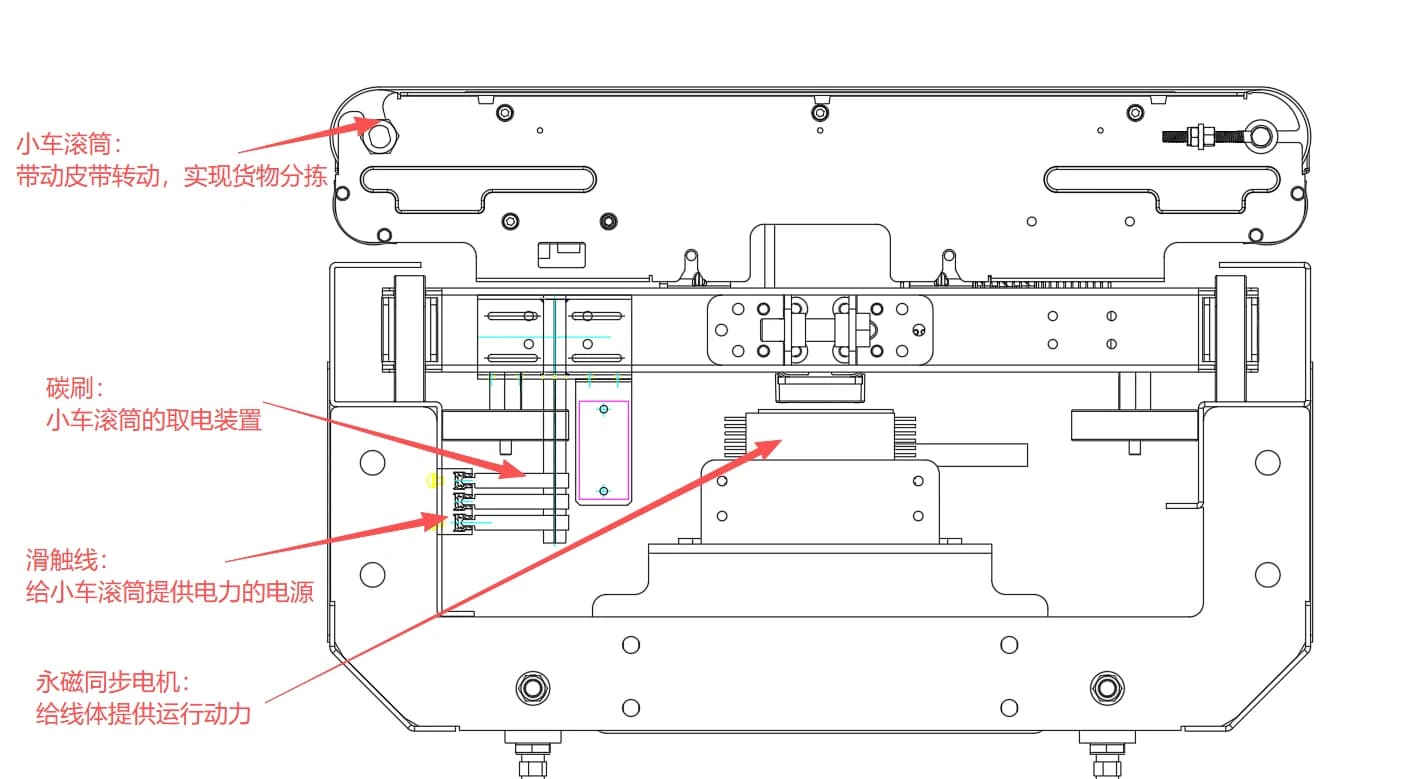
A cross-belt carrier needs electrical power for its short belt, local controls and related devices. A conventional architecture distributes power around the loop through conductor rails and sliding collector contacts. The approach is mature, but the electrical contact surfaces become inspection and replacement items, and the rail layout adds installation and expansion work.
Maintenance intervals cannot be generalized from one installation. Current, alignment, contamination, contact pressure, speed, operating hours and the rail profile all influence wear. The right comparison therefore starts with the existing system's measured failure and maintenance history rather than a universal replacement interval.
2. How an onboard generator wheel works
The generator wheel is mechanically driven by relative motion between the carrier and its running surface. The rotating wheel drives a compact generator, and power electronics rectify and regulate the electrical output before it is supplied to the cart load or an approved storage element.
The energy ultimately comes from the sorter drive. Generating electricity adds mechanical resistance that must be included in drive sizing and energy calculations. The engineering value is distributed local power and the removal of continuous sliding electrical contact—not the creation of energy without an input.
- Mechanical input from carrier movement
- Generator converts rotation into electrical output
- Rectification and regulation stabilize the supply
- Managed output feeds the cross-belt cart and controls
3. The MANZUN module concept
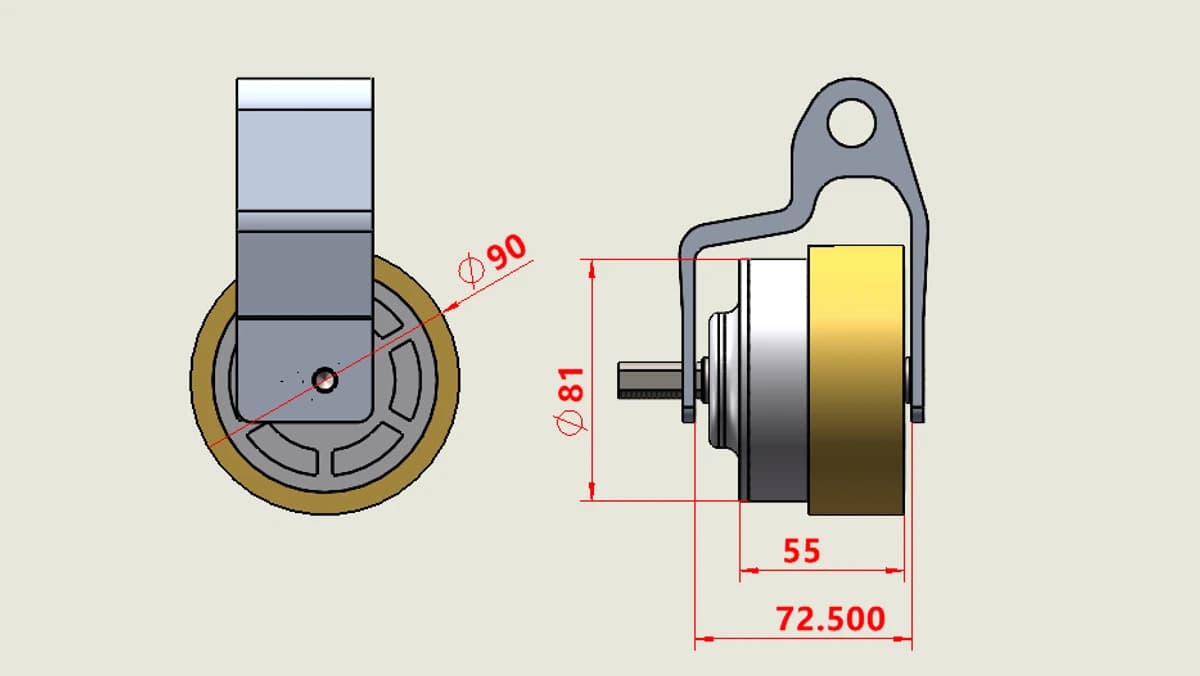
MANZUN's current development combines the generator, power-management electronics and transmission interface in a compact module intended for cross-belt sorter carriers. The source design uses a lightweight high-strength structure and a replaceable wheel assembly to reduce the packaging burden at cart level.
The dimensional illustration below is a product-development reference, not a universal mounting specification. Wheel position, preload, bracket stiffness, cable routing, clearances and service access must be reviewed against the target carrier and track before a retrofit or OEM configuration is released.
4. What changes compared with conductor rails
Removing the continuous conductor rail and brush interface can simplify track wiring and reduce maintenance associated with electrical sliding contact. It may also make phased expansion or certain retrofit layouts easier because power is generated locally on the moving carrier.
The trade-off is a different set of engineering controls. The generator wheel introduces rolling contact, bearings, a transmission interface, power electronics and additional drag. These parts still require inspection criteria, spare-parts planning and a defined fault response. Terms such as 'maintenance-free' should be replaced by a documented maintenance scope and expected service life under stated conditions.
5. Validation checklist for integrators
A bench demonstration is only the beginning. The module should be tested across minimum, normal and maximum operating speed, including acceleration, deceleration, low-speed sections and repeated stop-start duty. Output must remain compatible with the cart's real peak and transient demand.
Mechanical and electrical evidence should be reviewed together. A solution that meets voltage targets but creates excessive drag, heat, vibration or wheel wear is not ready for system release.
- Required voltage, continuous power, peak power and duty cycle
- Output stability at low speed, nominal speed and transients
- Wheel preload, slip, wear, contamination and track tolerance
- Added drive torque, heat rise, noise and vibration
- Protection against overvoltage, short circuit and loss of contact
- EMC, insulation, grounding and applicable machine-safety requirements
- Failure behavior, diagnostics, isolation and safe replacement procedure
- Environmental limits, cleaning method and spare-parts strategy
6. Build a project-specific lifecycle model
Lifecycle comparisons should use the customer's own operating calendar, electricity tariff, rail length, collector quantity, labor rate, planned downtime and replacement history. For the generator-wheel option, include module quantity, installation labor, drive-energy penalty, inspection tasks and expected replacement parts.
The MANZUN source material includes an illustrative 200-cart scenario and a night-shift retrofit sequence. Those values are useful as a worksheet structure, but the exact energy-saving percentage, installation duration and eight-year cost result are not published here because they depend on unverified project assumptions. A proposal should show the complete calculation so an integrator or operator can replace every assumption with site data.
7. Where this concept fits
Onboard generation is worth evaluating when collector maintenance, rail installation, loop expansion or cleanliness is a meaningful project constraint. A conventional conductor-rail system may remain the better choice when the carrier requires high continuous power, very low-speed operation dominates or an existing rail architecture is already reliable and easy to support.
Parcel Sort Lab prepared this engineering note from MANZUN product-development material. It describes the design questions around the concept rather than promising a universal performance or return. Final output, service life, compliance and commercial terms require a project-specific MANZUN and integrator review.
Frequently asked questions
Does a self-generating wheel create free energy?
No. It converts mechanical power from carrier movement into electrical power and adds a corresponding load to the sorter drive. The benefit is local power distribution without continuous sliding electrical contact.
Can it replace conductor rails on every cross-belt sorter?
No. Suitability depends on cart power demand, operating speed profile, mechanical interfaces, controls, environment, safety requirements and the existing track architecture.
Is an onboard generator wheel maintenance-free?
No mechanical or electrical module should be described as universally maintenance-free. Define inspection, wear limits, replacement access, diagnostics and spare parts for the intended duty.
What information is needed for a first review?
Provide the cart voltage and power profile, carrier pitch and quantity, speed range, operating calendar, track and wheel interface, environmental conditions, controls architecture and current collector-rail maintenance history.